Introduction
Hyperpigmentation is among the most common cosmetic skin concerns in Dubai’s diverse population. Excessive sun exposure, post-inflammatory pigmentation from acne, hormonal changes, and certain medical conditions can lead to uneven skin tone and dark patches that affect confidence and quality of life.
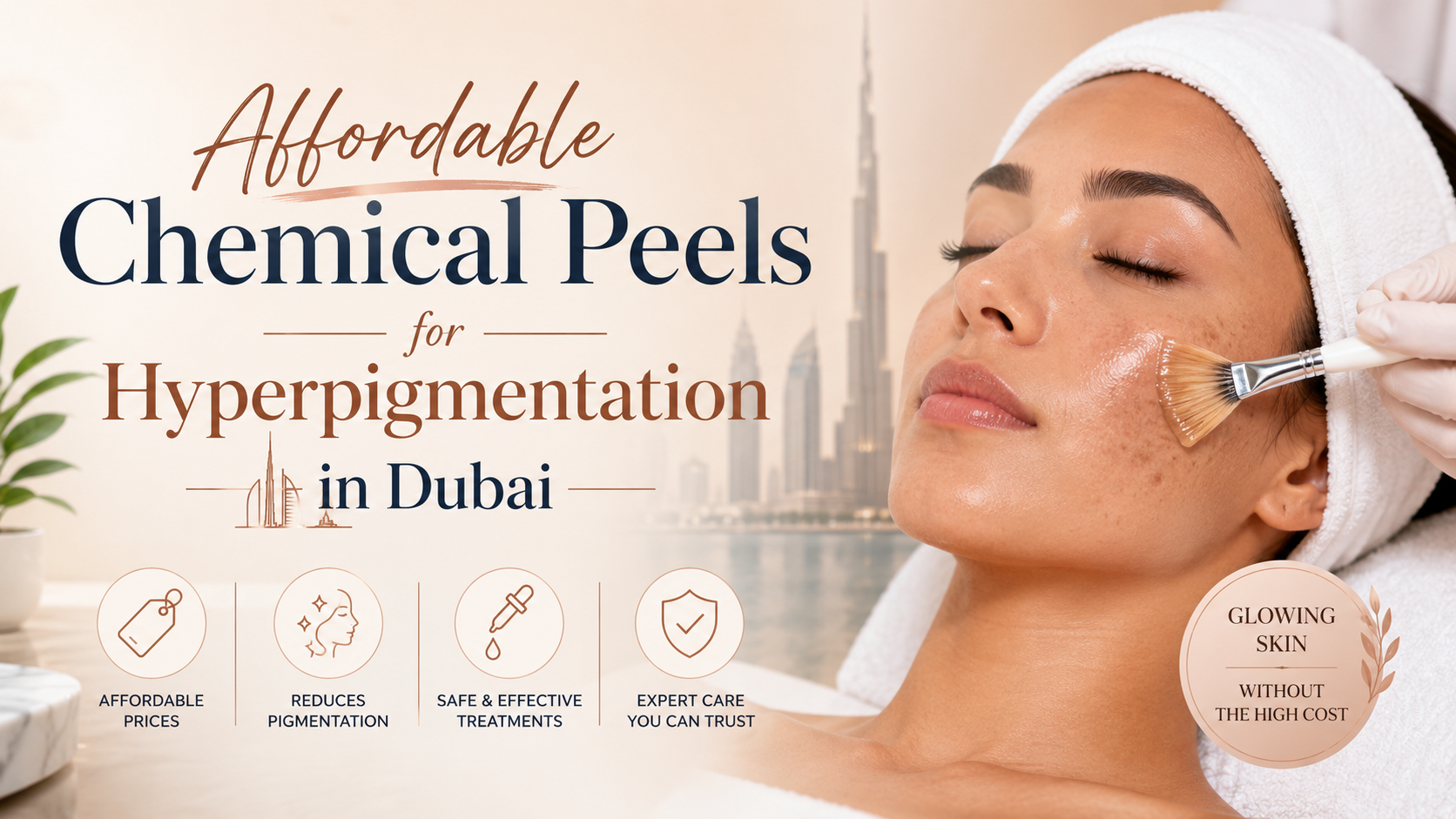
Chemical peels remain one of the most widely used non-surgical dermatologic treatments for hyperpigmentation. They can improve skin texture, promote cell turnover, and reduce the appearance of superficial pigment irregularities when appropriately selected and administered.
For patients seeking affordable options in Dubai, understanding the different types of peels, expected results, safety considerations, and realistic treatment costs is essential before making a decision.
Featured Snippet Answer
Affordable chemical peels for hyperpigmentation in Dubai typically include superficial peels containing glycolic acid, salicylic acid, lactic acid, mandelic acid, or low-concentration trichloroacetic acid (TCA). These treatments may help reduce pigmentation caused by sun damage, acne marks, and melasma, although multiple sessions are often required. Costs vary depending on the clinic, practitioner expertise, peel type, and treatment area. A professional skin assessment is recommended to determine suitability and minimize complications.
Key Takeaways
- Chemical peels help improve certain forms of hyperpigmentation by accelerating skin renewal.
- Superficial peels are generally the most affordable option.
- Multiple sessions are often necessary for visible improvement.
- Darker skin tones require careful peel selection to reduce the risk of post-inflammatory hyperpigmentation.
- Results vary depending on the underlying cause of pigmentation.
- Melasma can be particularly challenging and often requires combination treatment approaches.
- Professional evaluation is important before treatment.
Understanding Hyperpigmentation
Hyperpigmentation occurs when excess melanin accumulates within the skin.
Common forms include:
| Type | Description |
|---|---|
| Post-inflammatory hyperpigmentation (PIH) | Dark marks following acne, eczema, burns, or skin injury |
| Melasma | Symmetrical brown patches often linked to hormones and sun exposure |
| Solar lentigines | Sun-induced spots commonly called age spots |
| Freckles | Genetically influenced pigmented spots that may darken with UV exposure |
Symptoms of Hyperpigmentation
Individuals may notice:
- Brown, gray, or black patches
- Uneven skin tone
- Acne marks that persist after breakouts heal
- Sun spots on the face, hands, chest, or shoulders
- Symmetrical facial discoloration associated with melasma
- Persistent pigmentation despite skincare use
Causes of Hyperpigmentation
Several mechanisms can trigger excess melanin production:
Sun Exposure
Ultraviolet radiation stimulates melanocytes, increasing pigment production.
Acne and Inflammation
Inflammatory skin conditions may leave residual dark marks after healing.
Hormonal Influences
Pregnancy, oral contraceptives, and hormonal fluctuations can contribute to melasma.
Certain Medications
Some medications may increase photosensitivity or alter pigmentation patterns.
Skin Trauma
Burns, cosmetic procedures, and injuries may result in post-inflammatory pigmentation.
Risk Factors
Several factors increase susceptibility:
| Risk Factor | Potential Impact |
|---|---|
| Frequent sun exposure | Increased pigment production |
| Darker skin phototypes | Higher risk of PIH |
| History of acne | Persistent dark marks |
| Hormonal changes | Greater melasma risk |
| Inadequate sunscreen use | Pigment recurrence |
| Genetic predisposition | Increased susceptibility |
What Are Chemical Peels?
Chemical peels involve applying controlled chemical solutions to exfoliate the skin and stimulate regeneration.
Common peeling agents include:
- Glycolic acid
- Salicylic acid
- Mandelic acid
- Lactic acid
- Jessner’s solution
- Trichloroacetic acid (TCA)
The depth of penetration influences effectiveness, downtime, and risk.
Types of Affordable Chemical Peels Available in Dubai
Glycolic Acid Peels
Often considered a first-line option for mild pigmentation concerns.
Potential benefits:
- Improves skin brightness
- Enhances texture
- Minimal downtime
Salicylic Acid Peels
Frequently used when acne and pigmentation coexist.
Potential benefits:
- Exfoliates oily skin
- Helps reduce acne lesions
- Addresses superficial pigmentation
Mandelic Acid Peels
Particularly popular for darker skin tones.
Potential benefits:
- Gentle penetration
- Lower irritation potential
- Suitable for sensitive skin types
Lactic Acid Peels
Often chosen for individuals seeking mild exfoliation.
Potential benefits:
- Hydration support
- Improved skin radiance
- Reduced surface discoloration
Low-Concentration TCA Peels
May provide greater pigment reduction but require careful patient selection.
Diagnosis Before Treatment
A dermatologist may evaluate:
- Pigmentation type
- Skin phototype
- Medical history
- Previous treatments
- Current medications
- Sun exposure habits
Additional assessment may be necessary if pigmentation appears atypical or rapidly changing.
Differential Diagnosis
Not all dark skin patches represent simple hyperpigmentation.
| Condition | Features |
|---|---|
| Melasma | Symmetrical facial pigmentation |
| PIH | Follows inflammation or injury |
| Solar lentigines | Sun-related dark spots |
| Drug-induced pigmentation | Associated with medications |
| Acanthosis nigricans | Velvety darkened skin folds |
| Pigmented skin lesions | May require medical evaluation |
Any changing, irregular, or suspicious pigmented lesion should be evaluated promptly.
Treatment Options Beyond Chemical Peels
Chemical peels are only one component of treatment.
Topical Therapies
Commonly prescribed options may include:
- Retinoids
- Azelaic acid
- Vitamin C
- Hydroquinone (where appropriate and medically supervised)
- Tranexamic acid-containing formulations
Laser Treatments
Selected laser technologies may help some forms of pigmentation but are not suitable for every patient.
Combination Therapy
Many dermatologists combine:
- Chemical peels
- Topical agents
- Sun protection
- Maintenance skincare
Medication Considerations
Patients should discuss:
- Prescription retinoids
- Acne medications
- Photosensitizing drugs
- Hormonal therapies
- Pregnancy status
- Breastfeeding status
Certain medications may require temporary discontinuation before treatment under physician guidance.
Side Effects and Risks
Chemical peels are generally considered safe when performed appropriately, but risks exist.
Possible adverse effects include:
| Potential Side Effect | Description |
|---|---|
| Redness | Usually temporary |
| Dryness | Common during recovery |
| Peeling | Expected after treatment |
| Irritation | Varies by peel strength |
| Infection | Rare but possible |
| Scarring | Uncommon with proper care |
| Post-inflammatory hyperpigmentation | Higher risk in darker skin tones |
| Hypopigmentation | Rare lightening of treated skin |
Risk increases with stronger peels, improper aftercare, or inadequate patient selection.
Prevention and Maintenance
Long-term success depends heavily on prevention.
Recommended strategies:
- Daily broad-spectrum sunscreen
- Protective clothing
- Avoiding excessive sun exposure
- Consistent skincare routines
- Prompt treatment of acne and inflammation
- Regular dermatologic follow-up when needed
Prognosis and Expected Results
Outcomes depend on:
- Pigmentation cause
- Skin type
- Treatment consistency
- Sun protection habits
- Depth of pigmentation
Generally:
- Superficial pigmentation often responds better than deeper pigmentation.
- Multiple sessions are commonly needed.
- Maintenance treatments may be necessary.
- Melasma frequently recurs even after successful treatment.
Patients should maintain realistic expectations and understand that complete pigment removal is not always achievable.
Emergency Warning Signs After a Chemical Peel
Seek medical attention if any of the following occur:
- Severe swelling
- Extensive blistering
- Signs of infection
- Fever
- Significant pain
- Pus formation
- Rapidly worsening redness
- Unexpected skin discoloration
Evidence-Based Insights
Current dermatologic literature generally supports the use of superficial chemical peels as part of a comprehensive hyperpigmentation management strategy.
However:
- Results vary substantially among individuals.
- Evidence is stronger for some pigment disorders than others.
- Melasma remains difficult to treat and frequently relapses.
- Combination approaches often outperform single-treatment strategies.
The optimal treatment plan should be individualized based on skin type, pigmentation cause, and risk profile.
Chemical Peel Comparison Table
| Peel Type | Common Uses | Downtime | Relative Cost | Suitability for Darker Skin |
|---|---|---|---|---|
| Glycolic Acid | Mild pigmentation | Low | Lower | Moderate |
| Mandelic Acid | Sensitive skin, PIH | Low | Lower to moderate | Often favorable |
| Lactic Acid | Mild discoloration | Low | Lower | Generally suitable |
| Salicylic Acid | Acne-related pigmentation | Low | Lower to moderate | Often suitable |
| TCA | More resistant pigmentation | Moderate | Higher | Requires careful selection |
Cost Considerations in Dubai
Several factors influence pricing:
- Clinic reputation
- Dermatologist expertise
- Peel formulation
- Number of sessions
- Combination treatments
- Geographic location within Dubai
Patients should prioritize practitioner qualifications and safety rather than selecting treatment solely based on cost.
Expert-Level FAQs
Are chemical peels effective for acne-related dark spots?
They may help improve post-inflammatory hyperpigmentation, particularly when combined with proper skincare and sun protection.
How many sessions are usually required?
Many patients require multiple sessions, although the exact number varies depending on pigmentation severity and treatment goals.
Can chemical peels completely remove melasma?
Complete removal cannot be guaranteed. Melasma often improves but may recur, especially with ongoing sun exposure.
Are chemical peels safe for darker skin tones?
They can be safe when appropriately selected and administered by experienced professionals. Certain peel types may be preferred.
Is there downtime after treatment?
Superficial peels typically involve minimal downtime, while deeper peels may require longer recovery periods.
Can I wear makeup after a chemical peel?
Follow your treating clinician’s instructions. Timing depends on peel depth and skin recovery.
What should I avoid after treatment?
Common recommendations include avoiding excessive sun exposure, harsh skincare products, and picking at peeling skin.
Can chemical peels be combined with laser treatments?
In selected cases, combination approaches may be used, though timing and suitability should be determined by a dermatologist.
Who should avoid chemical peels?
Individuals with active skin infections, certain inflammatory skin conditions, recent isotretinoin use, or specific medical contraindications may require alternative approaches.
Internal Linking Opportunities
Consider linking to related resources such as:
- Melasma treatment options
- Post-inflammatory hyperpigmentation guide
- Acne scar management
- Daily sunscreen recommendations
- Retinoid skincare overview
- Laser treatment for pigmentation
- Dermatologist consultation guide
- Skin type and Fitzpatrick classification
Conclusion
Affordable chemical peels for hyperpigmentation in Dubai can offer meaningful improvement for many individuals struggling with uneven skin tone, acne marks, sun spots, and certain pigment disorders. Superficial peels such as glycolic acid, mandelic acid, lactic acid, and salicylic acid formulations are commonly used because they balance effectiveness, affordability, and safety.
The best outcomes typically occur when treatment is individualized, combined with rigorous sun protection, and supervised by qualified dermatology professionals. Because pigmentation disorders vary considerably in cause and severity, a comprehensive assessment remains the most reliable way to determine the safest and most effective treatment strategy.
Medical Disclaimer
This article is intended for educational purposes only and should not be considered medical advice, diagnosis, or treatment. Chemical peels may not be appropriate for every individual. Anyone considering treatment for hyperpigmentation should consult a qualified dermatologist or healthcare professional for personalized evaluation and recommendations. Results vary, and no cosmetic procedure can guarantee specific outcomes.
Leave a Reply